Living in the swarm
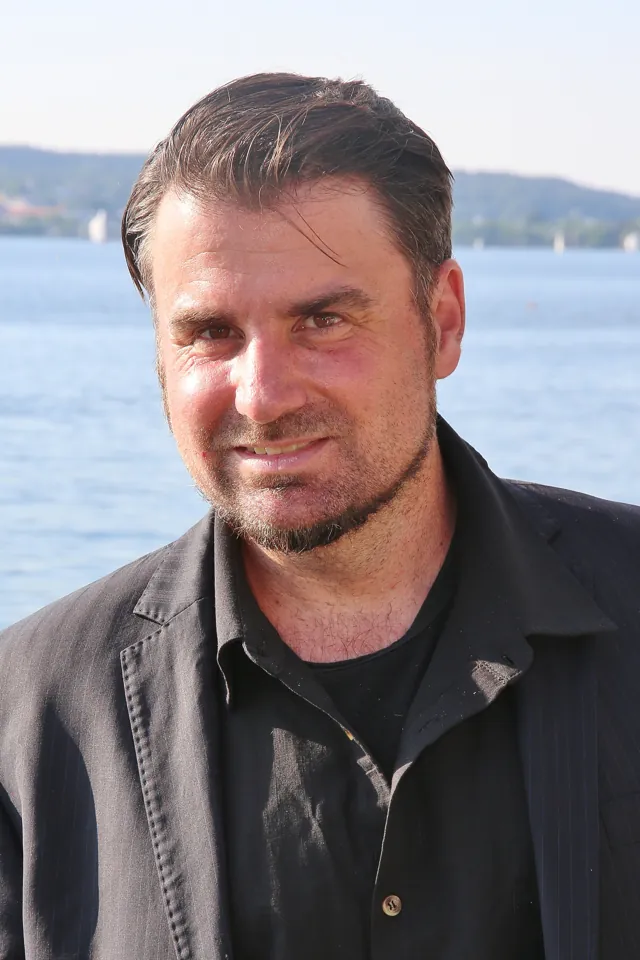
I’m Andreas, from Starnberg near Munich. I was in Frankfurt first, and for the July edition of Private Wealth Voices I wrote a piece about local AI. Some principals gave me questions afterwards, and today is a walk through those questions.
Some of this is for people who are just starting, because some principals told me they do not work with agents yet. Other parts are meant to give you another view of what I call a holistic performance system.
I come from performance science: learning and sports. In 2023 back problems restricted my movement. Since then I have worked with AI a great deal. That has become a long-running single-case study (N = 1); by my own count it is about 500,000 turns.
You see a lot of words on my slides. That is on purpose: I want us to look at things as if we were agents ourselves. You may read only the English, only the German, or the short line of code at the bottom. That is how agents try to get information out of a lot of data.
I try to work with AI as if I had glasses on that let me see the world through it all the time. That leads to a question for your office. If you have five people, is there anybody who does this with joy? Who has the time to work with AI all day and stay at the front? If nobody does, it may be good to have one AI expert who does exactly that.
Something also happens in your head. I ask a model, I wait, I read, I reply. While I wait, I ask another model. My next question may change without my noticing, because the beginning of the exchange may already have changed me.
The performance multiplier
When you work with AI a lot, you notice that there are questions you did not know you could ask. It helps to stay on a meta level and keep watching what happens to your own thinking.
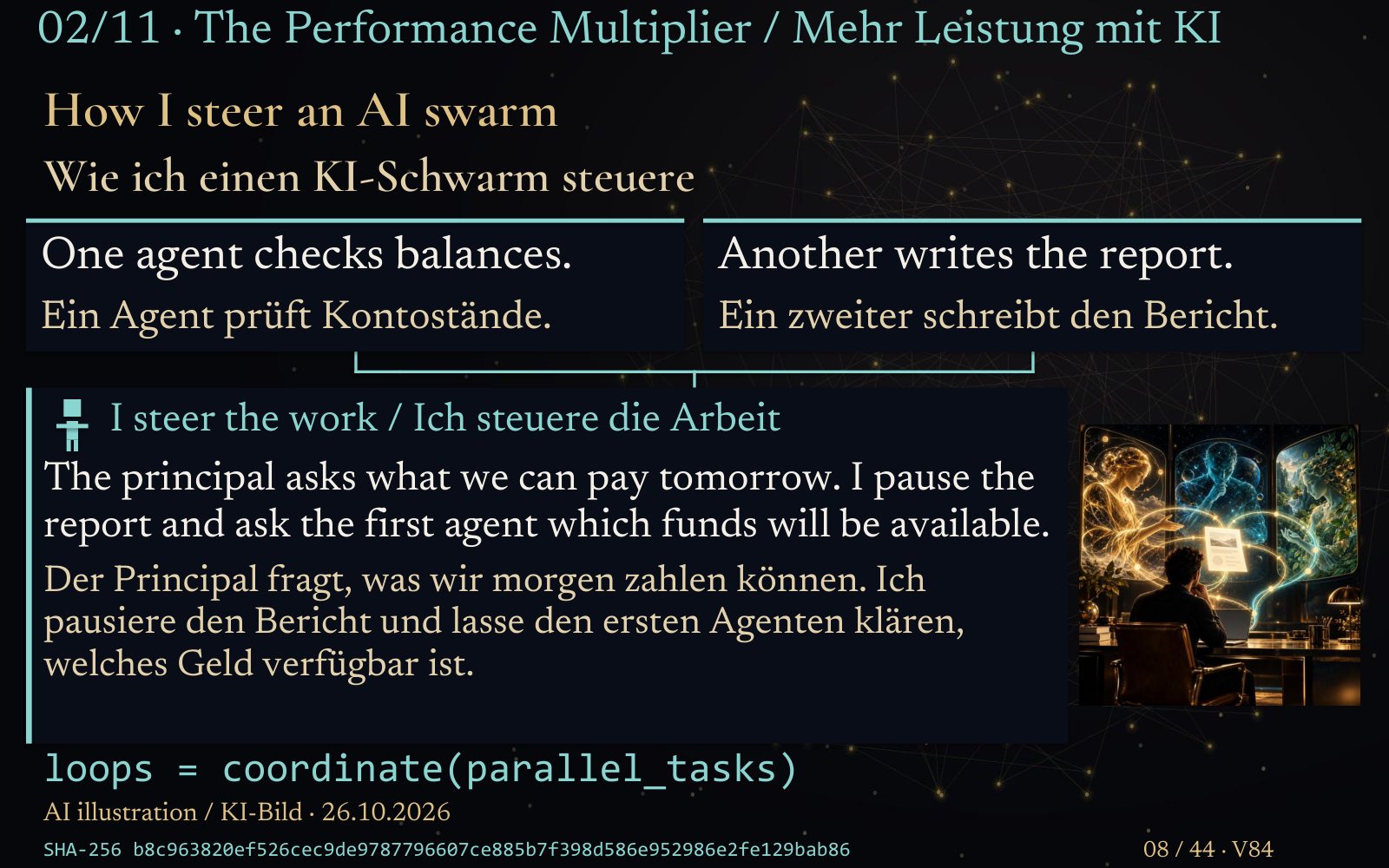
Many people ask how to start. For learning, you give every agent one thing to do. One checks balances, another writes the report, and at first you check what each of them does. When the principal asks something, you pause the report and do the other thing. With too many agents at the beginning, things may not work the way you thought. It can be easy, but it starts with very small steps.
Whether you run one agent, ten or a hundred: the time may be coming when one person can do the work of many, especially as the models keep improving.
The adoption gap
Many offices do not seem to trust agents yet. You can still start, if you start slowly.
Private AI would be my first step: a small server that is not connected to the internet, looked after by someone who specialises in it rather than doing it alongside everything else. With three or four people that is not possible. But I think the aim should be that one or more people work on making this system very good. If these systems keep getting better, it could be that the advantage goes to those who are best at working with AI.
The human inside the swarm
So I would say: find people who love this work. They do not have to be experts in every field; they can help the specialists get the best out of AI.
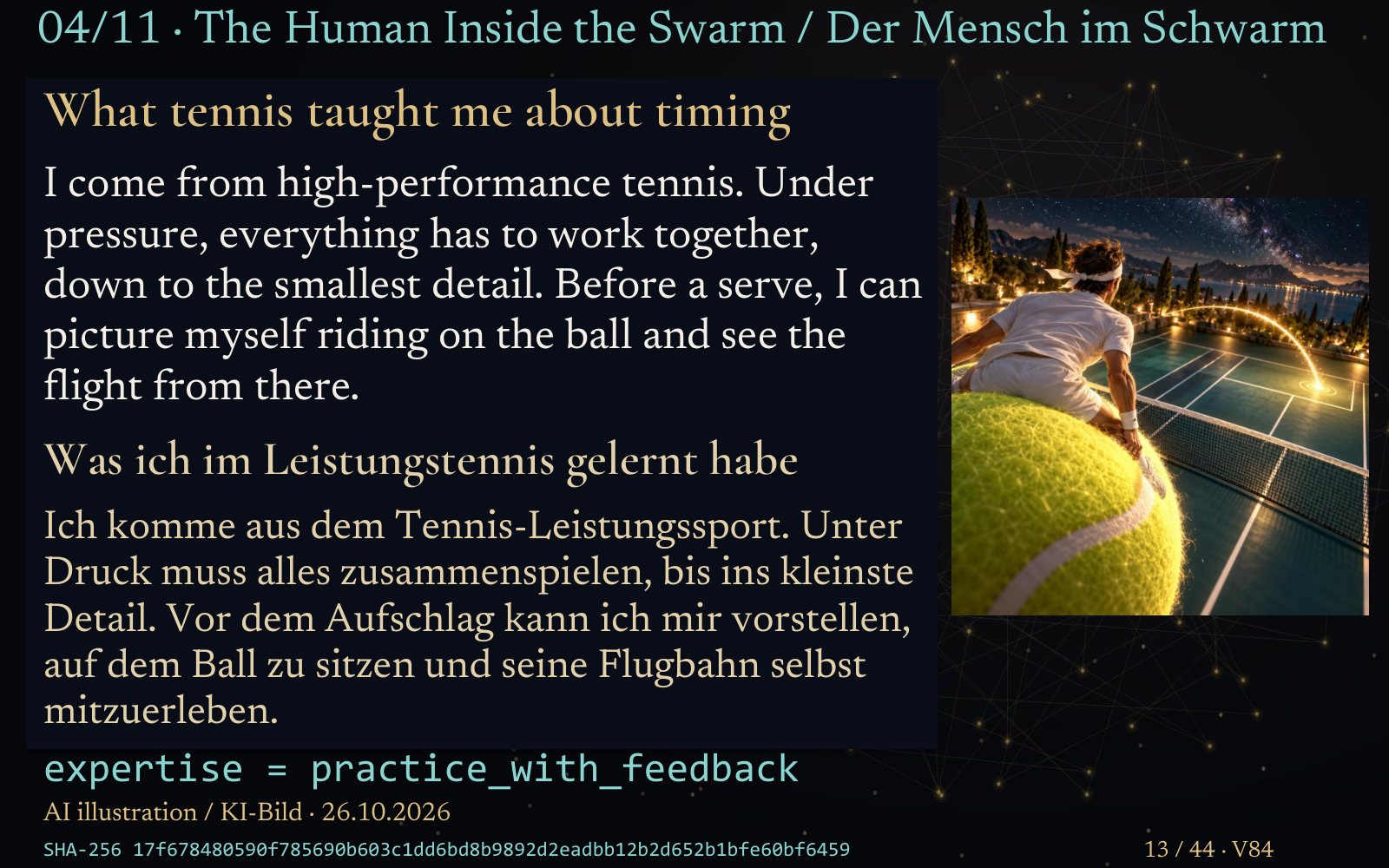
I come from performance tennis. Take your own hobby and ask: what is this agent doing, where does it get its knowledge from, where does it go on the internet? Some people told me it helps them to imagine being the instrument.
Think of the moment when driving a car became automatic for you: “I don’t think about what I’m doing, it just works.” That is the point we want to reach with AI: steering agents so naturally that it is not hard work for your brain. It is flow. The aim is to find the people who get there.
One first step: take three models and let them discuss the same question. Watch what they do. You see how they think and where the better solution may be.
And try taking the agent’s place. Imagine you are the agent reading an offer, but the page with the sale terms is missing. You see only the offer. Taking that view can help a lot.
It also helps to leave the desk. When I talk to several agents, several lines of thought run in parallel in my head. I call them loops. When I step outside and watch myself, I may find that three of ten loops are still running. Back at the computer I may see that the agents worked on nine of ten, and I on three.
Build deep expertise
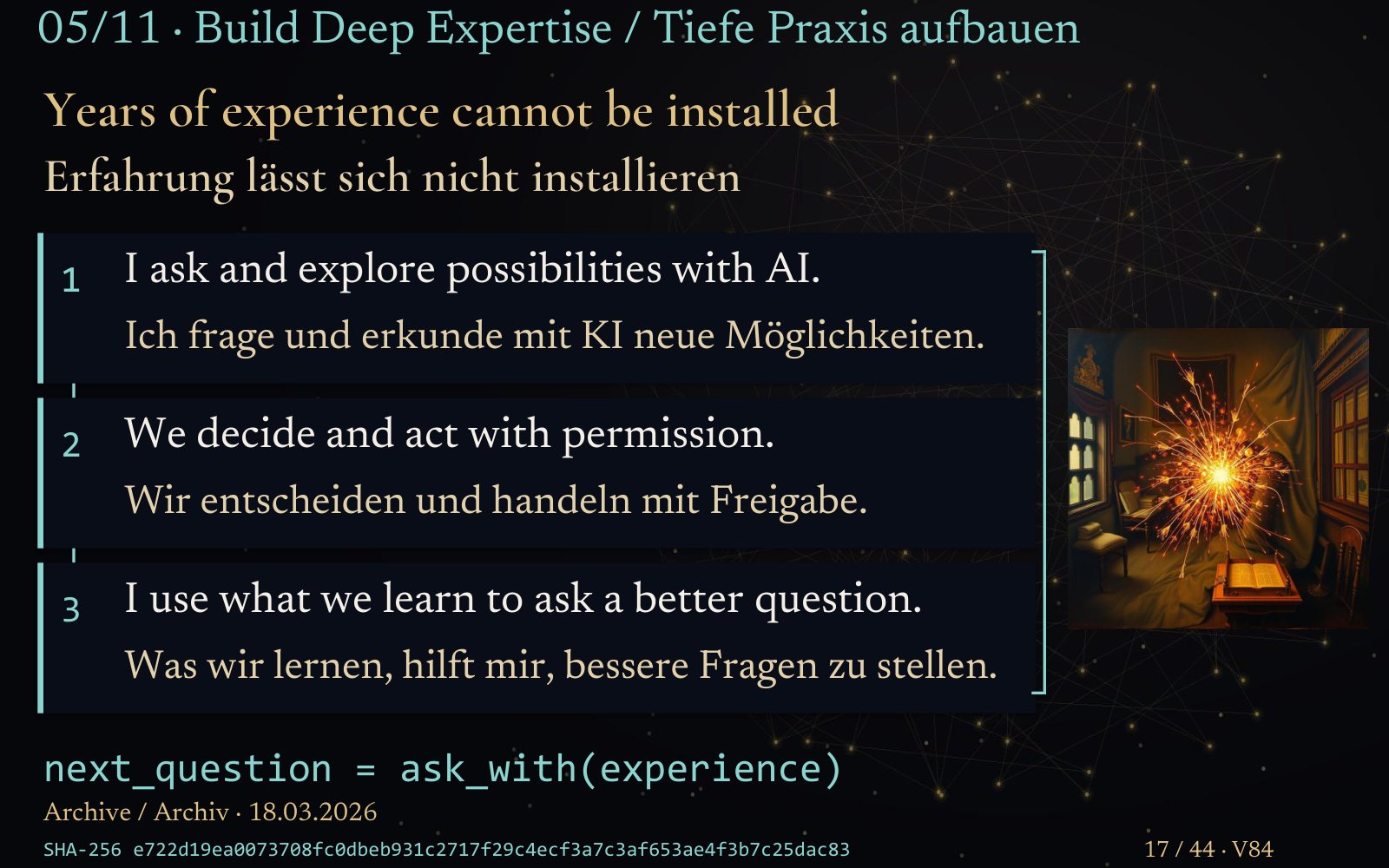
Building deep expertise, for me, is to ask and explore with very critical thinking, to decide and act, and then to ask a better question.
The memory of thinking
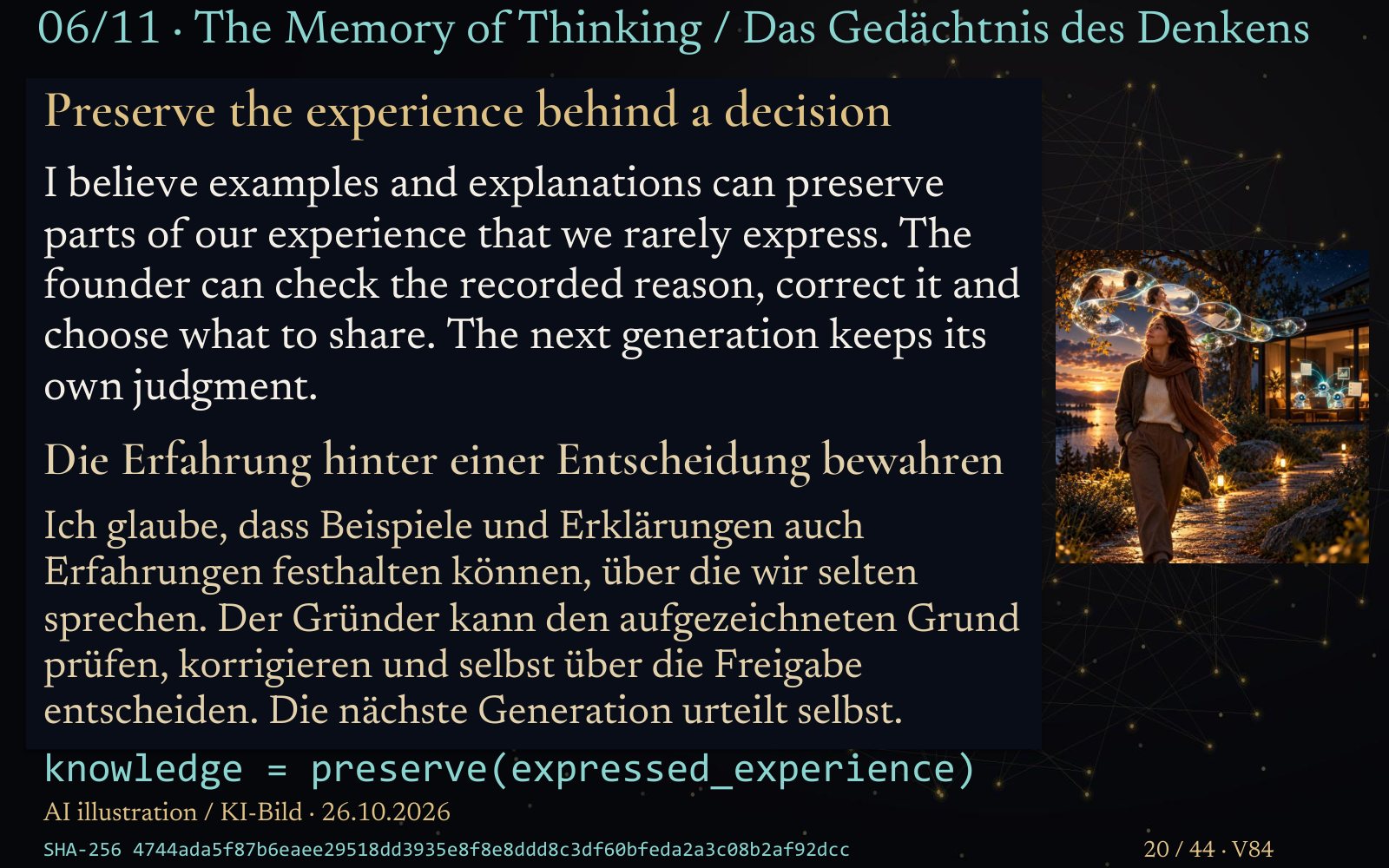
What is a memory of thinking? A local working memory. It has never been so easy for a company or a single person to timestamp thinking: decisions, reasons, corrections. If you do that over years on a private AI, you may be able to see very closely what you did. We all forget. Now there is a chance to analyse our history and to see what we could do better.
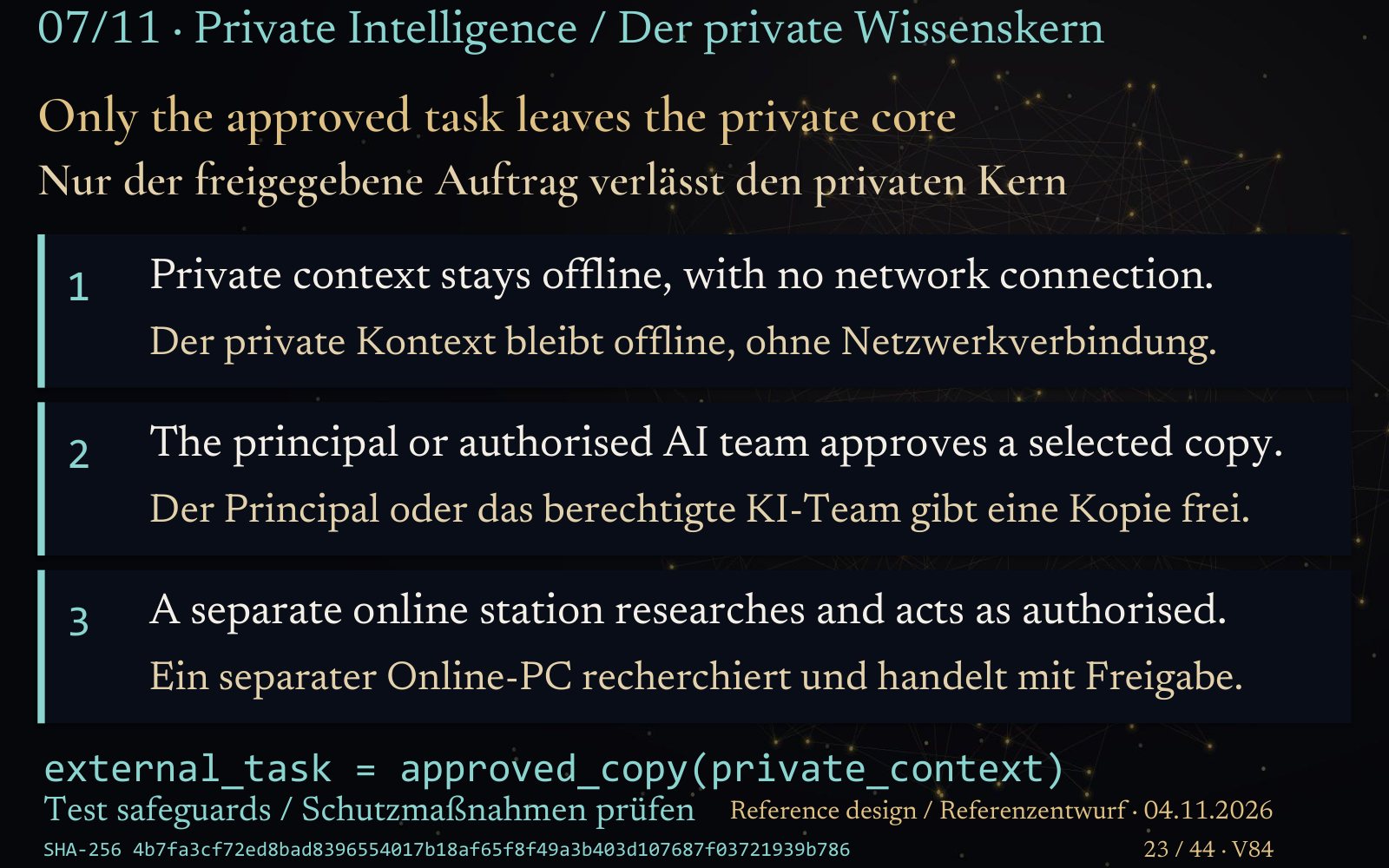
Examples and explanations can preserve parts of our experience. The founder can check the recorded reason, correct it and choose what to share. The border between the private AI and the outside matters a great deal. As I see it, the private core should have no direct connection to the internet; only an approved task is meant to leave it.
Private intelligence
The EU AI Act was not my topic today, but it is important.
You can start very small, with one local AI at one desk. Private context stays offline. If you also work with online AI, decide what is private and where the border lies, and make one person responsible for it.
On the private AI you can build ontologies. You give definitions: this is a car, and a car is not a glass. When you connect such definitions, you can record a little of the thinking behind a decision.
Real-world execution: a fictional case
Now a very simple, fictional example. You are offered a share in a painting. You may need the money in two years; the seller plans to sell the painting in five.
Agent one is a research agent. It reads the offer and finds no promise that you can sell early. Agent two is only allowed to draft an email, and at first you read every email before it goes out. Only when that has gone well many times do you let it send routine emails on its own for a while, and then check what happens.
Here is what can go wrong. The offer says: “We plan to sell the painting in five years.” A summary agent writes: “You can get your money back in five years.” The word “plan” is gone. That is one example of how meaning changes when information passes from agent to agent, or back to you.
Or take the word “safe”. The seller means the painting will hold its value. I want to know whether I can get my money out in two years. One word, two meanings. In German we call the children’s game “Flüsterpost”: after three or four stations the message is a different one. This explains a lot about why agent chains sometimes go wrong.
So the seller replies: no promise of a sale in year two. You pass; your business may need the cash.
When should the team wake you? When you are starting out: wherever money is involved in the decision, and whenever circumstances are not normal.
And what should the agent remember? Last time, you wanted to keep the money free for the business. Next time the agent asks: “Do you still need it in two years?” Your answer may have changed. That is timestamping: a decision is recorded with its date, and later it is checked against the situation as it is now.
“Dad, why did you turn down the share?”
One last example, again fictional. Your daughter opens the saved decision on the private AI. She sees the date, the seller’s reply and your own words: “My business may need this money in two years.”
“He declined the share” is what happened. It is not the decision. We also need the offer and how it was described. We need the reason. And behind the reason is the experience: “In 2003 my business needed cash. My money was tied up in a building.” That experience led to the decision.
Evidence and research
The private AI, the team, the agents and perhaps robots: this is one performance system, and you can measure it. That is what I try to do in my research. To measure it, you have to find words for the things you want to measure. That can be money, but also many other things, such as how the team works together.
Closing
Take one problem from your office and think about it afterwards. If you tried it with agents, where would the difference be? Which step would you no longer have to do? Thank you. I hope I answered some of the questions I was given in Frankfurt.